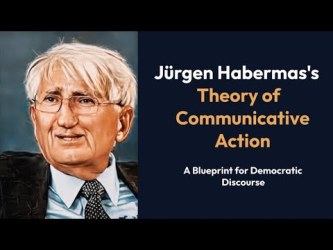
The Theory of Communicative
Action is a concept developed by German sociologist Jürgen Habermas,
primarily in his work The Theory of Communicative Action (1981). This
theory is centered on how communication, particularly the use of language, can
serve as a foundation for social coordination and cooperation in human
societies.
Habermas distinguishes between two
main types of actions in communication: instrumental action and communicative
action.
If we examine
Communicative Action,
it is an action which is based on the idea of mutual understanding. Two people
or groups engaging in communicative process desire to reach a consensus or
understanding through rational dialogue, discourse, debate etc. The main aim is
to achieve an agreement or harmony rather than simply further one’s personal
interest. The people or groups who are engaged in the communicative process try
to derive meaning through shared knowledge and meanings. Communicative Action requires cooperation and consent to create a
definite atmosphere of harmony. Habermas
introduces the term Lifeworld (Lebenswelt) which refers to the shared
knowledge of norms, values, belief systems embedded in the cultural ethos of
any society. In the current chaotic world people find it difficult to make
sense of the external world this Lifeworld (Lebenswelt) allows people to create meaningful
communication because it takes cognizance of the of the context helping people
to arrive at an understanding and agreement . The theory of Communicative
Action also introduces the concept of Discourse Ethics this posits that
the norms and values that govern society should be justified through open,
rational discourse. Thus calling for a more inclusive and participatory society
where societal decisions must be made by those who are affected by such values
and decisions, allowing a more open , inclusive and equal participation in the
discourse. The Validity of the speakers claims about the world, truth, and
norms can be tested against the ‘Truth-
Reality of the claims’, ‘Rightness-Moral
and Social stance of the speaker’ and ‘Truthfulness-Sincerity
of the intentions of the speaker’.
The challenge to the Communicative
Action comes through the power structures, control and colonization of Lifeworld. This distorts the communicative
action because human interaction becomes reduced to goal oriented behavior
which can easily be manipulated by those controlling the systems. Meaningful
dialogue loses its value to the power dynamics of communicators. Such situations
deny an equal opportunity of communication to creating power imbalances.
Instrumental action on the other hand is a
goal-oriented and strategic communicative process. It focuses on achieving
specific, often personal, outcomes, and is typically measured by success or
failure while it can be asserted that Communicative Action is oriented towards
achieving agreement and understanding and consensus among the people or groups
in the communicative process.
Theory of Communicative Action gains
importance as it emphasizes that communication is not just a tool for
transmitting information or achieving individual goals, instead, it is a means
of social interaction through which people create meaning, establish norms, and
build relationships.
The theory of communicative action
is foundational for understanding how societies function, how individuals
negotiate meaning, and how collective decisions are made through dialogue and
deliberation. This theory becomes especially useful in creation of shared
meaning to promote justice, equality, and democracy.