In
the age of information overload, the situation of teaching, learning and
imparting skill is challenging one. As we know that psychology always play
critical role in shaping one’s attitude, perception and belief system for
others. In this connection, a very important term comes while formation of
perception about student’s learning level i.e., Self-Fulfilling Prophecy.
In
teaching profession, the attitude and cognitive self of a faculty always play a
big role in motivating and inspiring a number of students.
Self-Fulfilling
Prophecy is highly related to performance expectations from student.
A self-fulfilling
prophesy refers to a phenomenon when a belief or
expectation has a direct impact on action, leading to the actualization of that
belief or expectation. Put simply, an individual's expectation of a specific
result influences their actions in a way that ultimately causes that result to
happen, even if it was unlikely at first (Robbins,
2024, p.196).
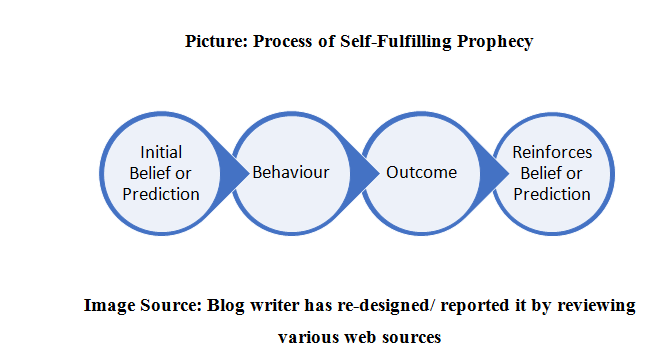
Following are the usual sequence of events while making initial belief:
1. Belief or Expectation:
An individual develops a conviction or anticipation regarding a
forthcoming event or outcome. This belief might have either a positive or bad
connotation.
2. Behavioural Confirmation:
It refers to the phenomenon where
an individual's belief has a direct impact on their behaviour, causing them to
act in a manner that is consistent with that belief. This conduct may encompass
acts, attitudes, or communication that inadvertently strengthens the belief.
3. Result:
The expected conclusion is confirmed due to their action, validating the
initial assumption or anticipation.
Application of Self- Fulfilling- Prophecy can be understood by an
example as described below:
Take, for instance, a teacher/faculty that has the belief that a
specific student possesses great skill in operations management. Due to this
conviction, the instructor may allocate additional focus and assistance to the
student, present more demanding numerical exercises, and articulate elevated expectations
for their academic achievements.
As a result, the student gets
more actively involved and self-assured in their operations management skills,
applies additional effort, and ultimately achieves excellence in operations
management domain, so confirming the teacher's initial opinion.
Conversely, when a teacher (faculty /instructors) holds the notion that a student lacks academic ability and treats them accordingly, the student may internalize this belief. As a result, their motivation and performance may decline, ultimately confirming the instructor's initial low expectations.
In this way, it can be summarized that faculty
members need to motivate students on positive manner irrespective of student’s,
Intelligence level, learning & backgrounds. Each student is unique so the
strategies to manage their concern must be designed positively because our
believe for them has many positive outcomes to realize by themselves. So, prime
facia, a faculty should avoid making judgemental shortcuts about students while
delivering their knowledge, skills, and abilities. Teachers’ valuable guidance and mentorship is
key role to play in holistic development of the youth of this age.