1. Introduction
We are going to see how the water used
in the curing can be neglected or reduced through the experiment. As we know
that 70 % water is available on our earth, out of which only 3 % water is
portable. Only portable water is used in construction industry. If we talk
about the construction industry, water is a key ingredient that is used. Water is added to concrete because it binds
other ingredients and also used in curing, which is necessary for concrete to
survive. So far no fluid can be found that can make concrete without water.
Know that water is necessary to make concrete.
Curing is needed because there is a lack
of water in the internal hydration of concrete. Therefore, while making
concrete, we should mix something so that there is no lack of water in its
internal hydration. We have added Polyvinyl Alcohol (PVC) as a super absorbent
polymer to overcome water scarcity in hydration of concrete. Such concrete
which do not require external curing are called Self-Curing of Concrete.
With the help of
self-curing, the concrete is kept moist. If
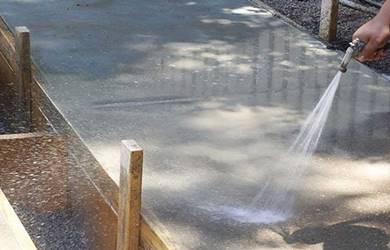
curing is done after the concrete is prepared, using external curing then
potable water is used more in this process. Concrete is self-curing to save
water. The function of self-curing
is to make the water
stay in the concrete
and hold it in the
beginning. There are many self-cured agents like
Polyvinyl Alcohol (PVA), Sodium Lignosulfonate (SL), Polyethylene Glycol (PEG)
etc. using which concrete is made self-cured.
2. Mechanism
of self-curing concrete
Chemical agents
are present in self-curing concrete that reduces the evaporation of water from
the concrete surface frequently by reducing the vapor pressure. Self-curing
agents that are added to the concrete mix form hydrogen bonds with the water
molecules and reduce the chemical potential of the molecules thereby, reducing
the vapour pressure and ultimately the rate of evaporation. The self-curing agents
have developed at the Concrete Technology units also give a variation in cement
hydration product microstructure. The compound molecules are firstly
hydrophobic in nature with hydrophilic terminal group. Hydrophilic terminal
group is automatically attached to the film of bleeding water. While the long
hydrophobic chain carry on a vertical orientation aside from the bleeding
water. Water molecules do not have enough energy to go out through the
hydrophobic layer. This process caused a sudden drop in evaporation loss.
A hydrophobic
molecule is one that has a proportion to comprise with or dissolved by water.
The hydrogen bond are partially redevelop by building water ‘cage' around the
compound molecules, the water molecules that form the ‘cage' have considerably
restricted mobilities.
3.
Durability of
self-curing concrete
Many literature
reviews have shown that the addition of several self-curing agents makes the
concrete quite durable. It was seen that surface absorption, carbonation,
freezing and thawing resistance characteristics were all are good in self-cured
concrete than conventionally cured concrete. These parameters are also depend
on the dosage of admixture added. After adding the admixture, the concrete
keeps the amount of water inside it high, so that the hydration of cement can
be done well. The use of different self-curing agents reduces the gross weight
of the concrete, which makes the design easier.
A durable
concrete is one that show satisfactory performance under exposed condition
during its service life. The specific feature of a self-curing concrete is its
good durability properties.
4. Methods
used in self-curing concrete
Following are the methods available for
self-curing of concrete-
·
Internal self-curing of concrete
·
External self-curing of concrete
4.1 Internal self-curing of concrete
Internal curing refers to giving
moisture for hydration of cement, which is already present in concrete by
opposing evaporation of water. Low-density fine aggregates or different polymer
particles with an ability to keep a noteworthy quantity of water can provide
extra moisture for concrete. Internal water is generally supplied through
internal reservoirs such as light weight aggregates, super absorbent polymers,
poly vinyl alcohol, saturated wood fibres etc. in the concrete.
Potential materials for
internal self-curing
Materials that can provide internal
water holding are as follows:
·
Light weight aggregates ( natural and
synthetic )
·
Super absorbent polymers ( 60-300 mm in
size )
·
Light weight fine aggregates ( water
absorption =20% )
·
Shrinkage reducing admixture ( SRA ) –
Polyethylene glycol (PEG)/ Polyvinyl alcohol (PVA)
·
Wood powder
4.2 External
self-curing of concrete
External
self-curing means that the moisture content available outside the concrete is
cured by pulling it towards itself after the use of curing compounds on the
concrete surface. Concrete's self-curing is done by using different self-curing
compounds. The curing admixture is applied via brushing or spraying on concrete
surfaces. It is widely used on large area concrete surfaces like road slabs,
bridge, airport runways etc. It is also suitable at places where it is
difficult to curing and for tunnel lining work. If the concrete surface is dry
where the curing compound is to be putted, then first you will damp the surface
with the help of water and then apply the curing compounds.
5.
Conclusion
The conclusions
based on the results of this experimental study are as follows:-
·
With the help of self-curing concrete,
where there is a shortage of water construction can also be done easily like in
desert areas.
·
A lot of money can be saved by using
self-curing concrete because the water used for curing will be saved.
·
It is seen from the experimental study
that there is an increase of 10.9 % compressive strength at 0.25% PVA
self-cured when compared to conventionally cured concrete.
·
Self-curing concrete is the best method
to reduce the application of water during construction.