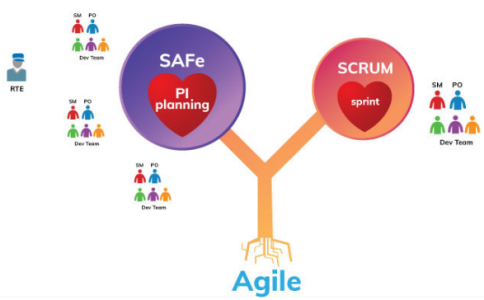
Within the community of software
developers, agile project management has gained popularity. Agile's flexibility
is a big part of its appeal. With its variety of approaches, we are able to
select an Agile framework that best fits our particular requirements or
advantages. In light of this, many organizations decide between the SAFe and
Scrum methodologies. Both frameworks are well-liked, yet they have distinct
organizational restructuring potential. Therefore, we need to take our goals
and resources into account while choosing between Scrum and SAFe. Here, I
discuss the advantages and disadvantages of both strategies to aid in selecting
the ideal framework.
Scrum : With the help of this Agile framework, autonomous,
small teams produce high-caliber software fast. Scrum development places a high
importance on simplicity and builds flexible teams that create products in
response to client feedback. Scrum divides big projects into smaller ones in order
to make this work.
Pros and cons of Scrum
To better understand
Scrum, here are its main advantages and drawbacks.
Pros:
·
Optimized development
processes
·
Emphasis on the end user’s
wants
·
Fast delivery times
·
Easy coordination within
small teams
Cons:
·
Difficult to scale to
larger projects
·
Requires team wide
training
·
Dev cycles may not always
align with project deadlines
SAFe : The
Scaled Agile Framework (SAFe) assists businesses in establishing goals and
satisfying client needs. SAFe is more broad than Scrum, which depends on small
teams and a focused emphasis. In order to develop products that are too big or
complicated for Scrum, it organises several teams and leaders. Scrum's
flexibility is traded for a more strict framework in SAFe. Although SAFe
promotes continual improvement, each team's goals are different. Nonetheless,
these disparate groups support one another and strive towards the same
objectives. SAFe is an organisational approach wherein specialised teams work
together to accomplish both customer and internal goals. Scrum, on the other
hand, is an agile framework wherein small, cross-functional teams self-organize
to meet evolving requirements and produce high-quality products fast.
Pros and cons of SAFe
To better understand SAFe,
here are its main advantages and drawbacks.
Pros:
·
Agility and a competitive
edge for businesses
·
Increased cooperation between
teams
·
Added barriers to prevent
product issues
·
Improved operations at an
enterprise level
Cons:
·
Poor fit for small businesses
and startups
·
Teams must learn shared Agile
language
·
Relies on a more rigid,
top-down framework
Although they differ, there are many similarities between Scrum
and SAFe. They both have a similar base as Agile frameworks. Below, we'll
outline the key areas of overlap:
·
Team-based development: Teams are more important
to Scrum and SAFe than individual developers. Production is advanced by
coordinated activities among one or more teams.
·
Incremental approaches to
high-quality deliveries: The finest products are delivered in smaller increments using
agile methodologies. SAFe divides stages into many teams, whereas Scrum divides
them into increments within a single team.
·
Cooperation with
stakeholders: Agile groups collaborate with stakeholders. When working
together, they may evaluate needs, exchange opinions, take into account client
recommendations, and make changes either prior to or following a product's
release.
·
Inspect and adapt
strategies: A part is played by
routine inspections and direction changes. Every sprint in Scrum is followed by
a review. These inspections occur during the release train in SAFe. These
inspections may result in changes to the development priorities.
·
Timeboxing: Timeboxing is used in both
strategies to manage time. Timeboxing is all about allotting the greatest
amount of time required to do a task. Projects remain on schedule when stages
are completed in the timebox.
·
Continuous delivery
pipelines (CDP): A continuous delivery pipeline is utilised by SAFe and Scrum.
Software updates are distributed frequently and on a regular basis using this
method. Additionally, it makes use of automation to expedite the testing,
staging, and production of goods.
It is necessary to consider an organization's objectives,
structure, and procedures while choosing the best Agile strategy. The following
aspects should be considered while choosing between Scrum and SAFe. Selecting
between SAFe and Scrum needs serious thought. Leaders must balance their
objectives and resources with the requirements of each framework. Although it
takes time to understand, Agile may completely change the way you approach
development. You can satisfy consumer requirements and make your company run
like well-oiled machinery with the appropriate strategy.