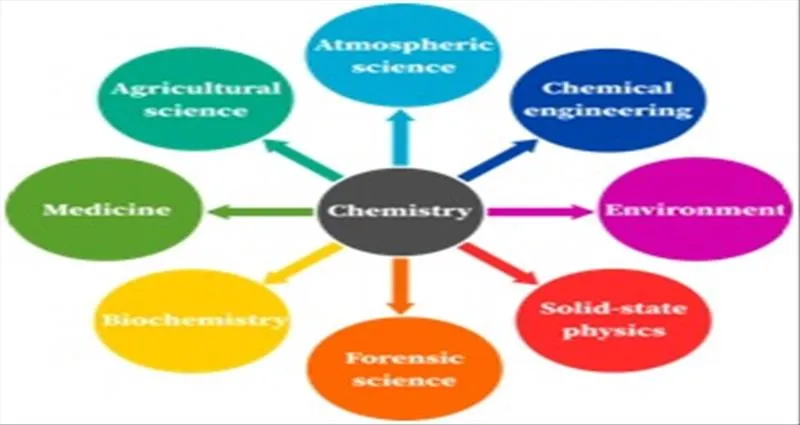
Changes within the engineering education are necessary to deal with the rapidly changing needs of our society. One of the changes might be introducing electives of basic science within the higher semesters, as science is that the backbone of engineering. An engineering graduate is predicted to use the knowledge of science and arithmetic to unravel problems of the society. As chemistry is extremely important but foremost neglected basic science, therefore in this article the role of chemistry in engineering education is emphasized How Applications of Chemistry can reinforce the engineering education is discussed.
Chemistry and basic sciences generally aren't cultural complements but form a very important basis so as to supply a piece force of versatile and open minded engineering professionals, able to adapt to scientific and technological innovations. It is important to style the programs with relevant chemistry subjects for the integral education of the scholars, with a true link to the engineering subjects. An undergraduate course in engineering involves a chemistry subject for only one semester, which provides a really surface knowledge in chemistry. This surface knowledge in chemistry isn't sufficient for solving engineering problems. Chemistry electives in higher semesters can help students for contemporary industrial challenges in an increasingly competitive global marketplace.
In undergraduate engineering programs, the basic sciences (Physics, Chemistry and Mathematics) are a group of subjects which play pivotal role. Chemistry may be a part of basic sciences and it's referred to as central science, because it's important to numerous other fields of scientific study.
Mechanical engineering: It involves the planning, production, analysis and maintenance of mechanical systems. Except design, chemistry plays a really important role altogether other engineering fields. Ex; Energy science and engineering, Nanotechnology, Material science and engineering, Tribology (study associated with friction) etc., require thorough knowledge of chemistry which are parts of engineering.
Energy science and engineering: Energy is one among the foremost significant challenges facing humanity and may be a central focus of mechanical engineering’s contribution to society. Hence engineering students require to study detailed elective courses on chemical fuels and Combustion chemistry.
Nanotechnology: The miniaturization of devices and systems of ever increasing complexity has been a desirable and productive engineering endeavor during the past few decades. Micro and nanotechnology can have tremendous impact on a good range of mechanical systems [Ex: Micro or Nano electromechanical systems (MEMS/NEMS) which needs the knowledge of chemistry at molecular level]. In order to organize the scholars of engineering in miniaturing of devices, certainly, need an in depth elective course on Nano-chemistry.
Material science and engineering, which may be a part of engineering rest heavily on chemistry , while there are more traditional applications in polymer processes, new areas of development are in composite and advanced materials. An elective course in “Physical chemistry” (or chemistry of materials) is vital, so on organize the students of engineering in materials science and engineering.
Civil engineering: Civil engineering could also be knowledgeable engineering discipline that deals with the design, construction and maintenance of the physical and naturally built environment, including works like roads, bridges, canals, dams and buildings. There are various sub-disciplines in civil engineering. For ex: structural engineering, transportation engineering, environmental engineering, etc.
Structural Engineering: Structural engineering is based on the knowledge of properties of materials so and their ability to resist loads. Some common but important structural materials are; Iron, Aluminium, Composite materials, fiber reinforced plastics, concrete, Alloys, clay, etc. Life of any building or construction depends on the standard of those materials. Rate of corrosion of metals also play a really important role in determining the lifetime of any building. Many researchers are trying to develop ecofriendly construction materials for sustainable habitats. Research within the world of Self healing materials, flame retardant and rust retardant materials is additionally learning. Hence, chemistry electives within the higher semesters on “chemistry of construction materials”, “Smart materials” and “Corrosion and its control” will certainly equip the scholars of engineering to unravel real life problems.
Environmental Engineering: Environmental engineering rests heavily on the appliance chemistry to the environment. The purpose of environmental engineering is to make systems and methods to treat waste streams; produce safe drinking water; control storm water; manage solid waste, hazardous waste and radio active waste; clean up environmental contamination. Hence, chemistry electives like “water and waste water treatment”, “environmental chemistry” and “environmental pollution” will enhance the knowledge of engineering students during this field.
Electrical engineering, Electronics and Computer Science: Electrical engineering is that the branch of engineering that studies the uses of electricity and equipment for power generation and distribution and therefore the control of machines and communication. Computer Science and Electronics and communication are also considered as an area of EE science. Semiconductors are extensively utilized in electronic and computing engineering. Microelectronic components are created by chemically fabricating wafers of semiconductors like silicon, germanium, metal oxides (CMOS) etc. Chemical image processing (hyper spectral and multispectral) may be a part of electronic and computing engineering needs the knowledge of molecular spectroscopy. Electrochemistry forms the idea for batteries and fuel cells. Liquid crystals and organic light emitting diodes (OLEDs) are very useful in electronic display technology. The electrical engineering involves a significant amount of chemistry and hence elective courses on “chemistry of electrical engineering materials”, “electrochemistry”, “spectroscopy” and “Liquid crystals & OLEDs” will be beneficial to broaden the knowledge base of students.
Apart from above mentioned electives, Subjects like “Optical and Electrochemical Sensors” “Polymer chemistry” & “composite materials” are also quite useful in covering 360 degree engineering education.