India's National Education Policy (NEP) 2020 marks a
transformative shift in the way we approach higher education. Among its many
forward-thinking reforms, the introduction of the Multiple Entry and Multiple
Exit (ME-ME) system stands out as a revolutionary stride toward accessibility,
flexibility, and inclusivity.
In a country as diverse and dynamic as India—where
students often face disruptions due to financial, personal, or geographical
constraints—this policy is more than just a reform. It is a redefinition of
empowerment in education.
What Is ME-MEAll About ?
Traditionally, higher education in India followed a
rigid structure. If a student had to drop out mid-course, their progress was
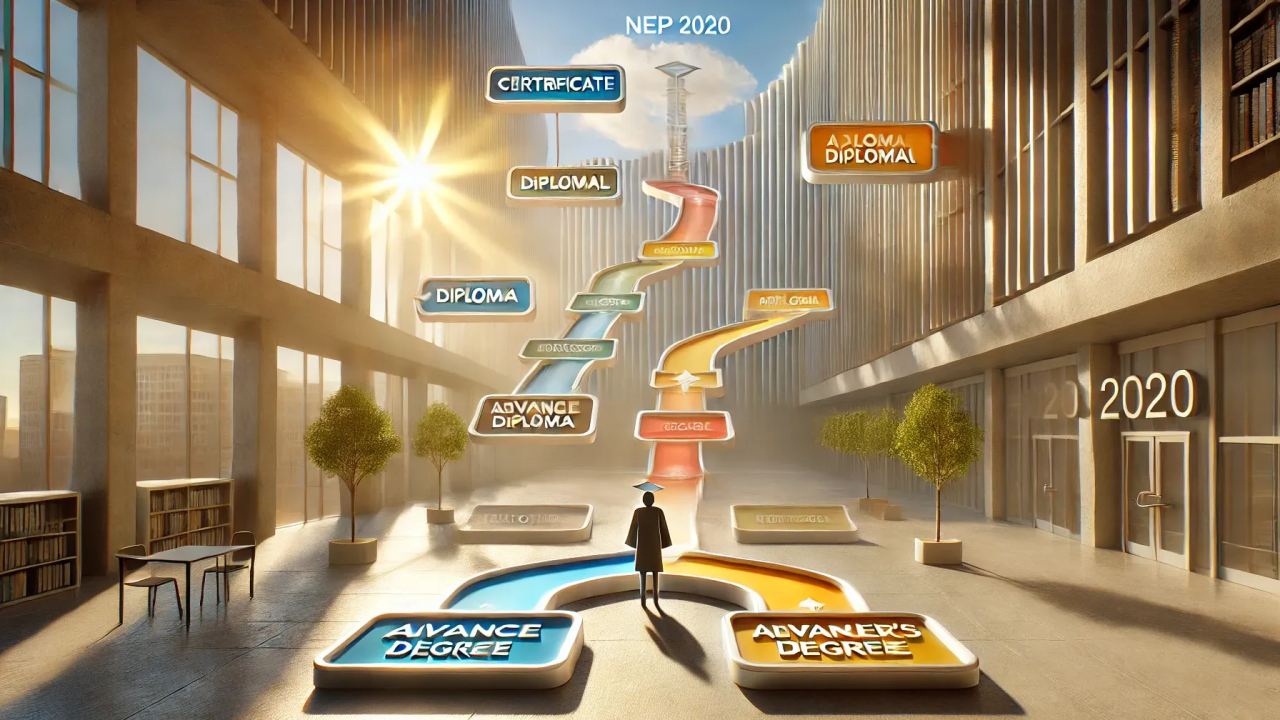
often lost. NEP 2020 challenges this inflexibility by introducing a staircase
model of education instead of a one-way tunnel.
Under ME-ME, students can enter and exit academic
programs at multiple points and still earn recognizable qualifications:
·
After 1year: Certificate
·
After 2years: Diploma
·
After 3years: Bachelor’s Degree
·
After 4years: Bachelor’s Degree with
Research (optional fourth year)
These milestones ensure that students who pause their
education still walk away with something tangible and valuable—and, more
importantly, they can return later to continue from where they left off.
How Does It Work ?
The backbone of this flexible system is the Academic
Bank of Credits (ABC), a digital repository where students’ academic credits
are stored safely. This enables:
·
Credit mobility across institutions
·
Seamless transfers between courses or
disciplines
·
The option to re-enter the education system
anytime, anywhere.
This is not just a structural change—it’s a cultural
shift that aligns education with the complexities of real life.
Why It Matters ?
1. Flexibility :
Life is unpredictable. ME-ME respects the individual journeys of learners,
allowing them to choose their pace and path without penalty.
2. Inclusivity : For
marginalized communities and first-generation learners, ME-ME offers dignity,
opportunity, and hope. Education no longer needs to be sacrificed due to
short-term responsibilities or challenges.
3. Mobility : Students
can transfer between institutions—or even disciplines—without having to start
over. This boosts academic freedom and personal growth.
4. Skill-Based Recognition : Each
exit point grants a recognized qualification, making even short-term education
career-relevant and goal oriented.
Real-World Impact
Imagine a student who has to leave college after one
year to support their family. Previously, that year might have been a waste.
But under ME-ME, they leave with a certified qualification and the option to
return anytime to build upon it.
This approach transforms higher education into a
lifelong, adaptable journey, not a single-shot opportunity.
The Road Ahead
·
The vision of ME-ME is bold—but success
will depend on effective implementation: Institutions must develop robust
systems for credit transfers and validation.
·
Quality assurance mechanisms must be
standardized.
·
Student counselling and support services
will play a critical role in guiding learners through these flexible pathways.
With these foundations in place, ME-ME can
revolutionize the way India educates, ensuring no student is ever left behind
due to circumstances beyond their control.
Conclusion
The Multiple Entry and Exit system under NEP 2020 is
more than an academic policy—it’s a powerful statement about what education
should be: inclusive, flexible, learner-centric, and future-ready. As we move
forward, ME-ME has the potential to make Indian higher education not only more
responsive to societal needs but also deeply humane in its approach.