The world is still being misled, says Prof. Bharat Raj Singh
According to the IPCC recent report, the reduction in the amount of Arctic sea ice during the first week of July, 2021 was quite rapid, but slowed down afterwards. The monthly mean extent of July 2021 was 76,69,000 square kilometers (29,70,000 sq mi). This decreased by 5.21% from the record low of 4,00,000 square kilometers (154,000 sq mi) i.e. 80,69,000 square kilometers for the month set in 2020 (July 2000) and 17,80,000 square kilometers (687,000 sq mi) from the 1981 to 2010 average. sq mi i.e. 30.22% less than 94,49,000 sq km. Although the decrease in ice volume has now slowed down in August and this situation will be minimal in September 2021, from this we can imagine that there has been a decrease of 53.8 to 60.52% of the ice volume relative to the three months 1981 to 2010. The month's average range is the fourth lowest in the passive microwave satellite record. The rapid ice loss in the Laptev Sea at the beginning of the melting season has slowed, but the extent in Laptev is well below average, but the ice extent in the Beaufort and Chukchi Seas remains close to the long-term average.
It is also clear from this that due to carbon emissions; the temperature will reach 1.5 - 1.6 °C in the 2030s; whereas earlier it was said that the temperature would drop to 1.4°C by the end of the century. The report also said that India is projected to trigger a global warming average over India and is expected to see an increase in the heat frequency, its extremes and its severity, and the monsoon rainfall is also projected to increase rapidly, leading to an increase in annual rainfall and average rainfall will also increase.
The report said that the global mean sea level in the Indian Ocean is rising at a rate of 3.7 meters annually. According to the report, there could be an increase of about 20 percent in rainfall relative to 1850-1900 over the south-west coast. If the planet warms by 4 degrees Celsius, India could see an increase of about 40 percent in annual rainfall. The increase in rainfall will be more severe over the southern parts of the country.
Globally, severe & heavy rainfall events that now occur on average once every ten years are 1.7 times as many now. But over a ten-year period at 2 °C, the frequency is projected to nearly double, and at 4 °C, the probability of these events will increase to 2.7 times over a ten-year period, the report's authors warned.
Prof. Bharat Raj Singh Environmentalist, School of Management Sciences, Lucknow (affiliated with AKTU), who has warned through his articles and journal papers on climate change and global temperature rise since 1995 that the threat of climate change is to protect mankind and other animals. Fightening for this, he says that the world's institutions related to snow and glaciers, climate change and global temperature control did not put it vigorously in 2014 even in the Paris Committee held in Nov.-Dec 2014. Although the Prime Minister of India agreed to reduce carbon by 2% and appealed to all the countries. But America disagreed with accepting the suggestion of the Paris Committee. Even the IPCC's 2007 report said that they would be able to stop the increase in temperature by 1.5 °C, which is fatal, by 2015.
If we look at some of the earlier cautionary suggestions of Prof. Singh, then what is being said in the today’s Report-2021, he has already tried to awaken the whole world from 2012 to 2016 by publishing it through electronic or print media, magazines and papers printed in leading journals etc. Some examples are given below-
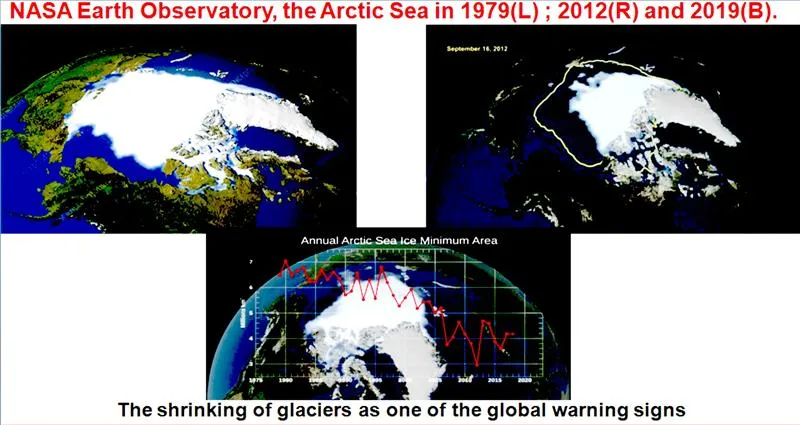
1). A book chapter by Dr. Singh that was included in the curriculum for Classes 10-12 in the US in 2014, summarizes the title of the book: “The Melting of Glaciers Cannot Be Reverted Back With Global Warming” That is—ice sheets and glaciers are more vulnerable to climate-change than previously estimated. According to a recent study, if the temperature rises above the 1.6 °C threshold from the pre-industrial level (-) 0.8 °C increase that has already been recorded, then the Green-Land ice sheets will be completely gone, the kind of melt it continuing. Satellite images also show that Arctic sea ice fell to a record low in August 2012, and scientists predict ice caps will disappear during the summer over the next two-decades (by 2030).Research shows that 70 percent of the sea ice in the Arctic is the result of man-made. The on-going climate change concludes that this is an alarm call to significantly reduce carbon emissions and focus on renewable energy sources.(Ref- Melting of Glaciers Can't Be Back With Global Warming - 2014, Green Haven Publishing, New York, US, Chapter-7, pp. 56-63)
2). Dr. Singh told the people of the world through a research chapter of his book, Global Warming-2015 that the Earth's land area is 1489,40,000 sq-km (29.2%) and water is 3611,32,000 sq-km. (70.8%) i.e. each mm of increase in sea ice will cause a change in the melting water. The ice sheet covering Antarctica and Greenland accounts for about 99.5 percent of the Earth's glacier ice mass in Greenland and the poles, which has the potential to raise sea levels by 63 meters (about 200 feet) if it were completely melted from covered portion. The ice mass in Greenland extends to 680,000 cubic meters, with an average thickness of 3 miles (4.8 km), covering three-quarters of the island. Some glaciers, especially in the southeast and northwest, have caused water levels to rise by as much as 15% over a period of the past 20 years due to the increasing amount of ice dumped in the surrounding ocean. Analysis shows that between April 2003 and April 2012, the region is melting at a rate of 10 billion tonnes per year, leading to a minimum melting of 397.245 trillion tonnes by the end of the 21st century. The maximum could be 1100–1450 trillion tons, which could lead to a maximum sea level rise of 3.6 feet (1.1 m) to a maximum of 10–13 feet (3.4 m), respectively. Due to this, by changing the load shift of ice from poles to the north / south coast towards the sea, the water will accommodates middle-longitude in the ocean and there can be a change of (+) or (-) in the spinning angle of the earth which is 23.43 degrees. It could be a dark day on this beautiful planet- Earth, when the entire livelihood may have to face the dire consequences of its end up. Taking forward the research work of Dr. Singh, University of Alberta, Canada, Prof. Mathui Dummery has indicated a slowing of the Earth's speed by 1.7 milliseconds in December 2015. (Ref-Global Warming-2015, Intake Publishers, Chapter-3 Pages 65-67)
3). Dr. Singh has also written in his book, Global Warming-2015, in his second research chapter, that from 2020 to 2030, it will not be beyond reality, while most of the ice of the poles will be found on the ocean basin and from the map of North America, will remain ice free and there is a possibility of glacier formation near the northern coasts due to heavy ice sheets. It is also expected that by 2040 there will be only a small amount of sea ice in the Canadian region along the northern coasts of Greenland, USA. Since the ice sheets that meet with sea water which will fold at minus (-) 60-70 degrees centigrade, will not be able to convert to water as quickly and can create pressure drop. Due to which the extreme temperature will drop and take the form of snow. Not only this, the northern region of USA and UK may be affected by cold waves, disasters, intense storms, may not be conducive to live life due to heavy snowfall. Due to the cold wave, the temperature will drop drastically, forcing the population living in North America and in the European region to leave their habitat and find new places.
The Asian region, especially India, which is surrounded by the sea on three sides and the Himalayan hills on the fourth side, can be severely affected by devastating severe storms, cold waves, and heavy rains, respectively, and the glaciers around the region in the Himalayas. Heavy snow cliffs are likely to keep falling nearby, causing huge damage to life and livelihood. It is expected that the situation may go from bad to worst every year and will continue for the next decades. During the winter, New York, the UK and Canada, the northern belt, will continue to suffer from extreme weather conditions such as: intense storms, heavy snowfall and power outages. (Ref-Global Warming-2015, Intake Publishers, Chapter-2 Pages 38-40)