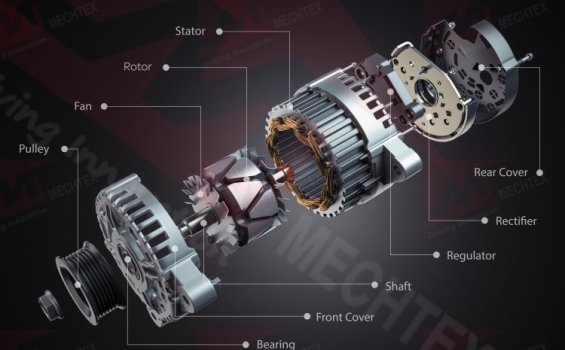
Overview of Brushless DC motor (BLDC Motor)

A BLDC Motor is also known as a brushless DC motor. This is an electric motor that operates without brushes, unlike traditional brushed DC motors. Instead of using brushes and a commutator to switch the current direction, BLDC motors use electronic controllers to do the switching.  BLDC motor is very popular in various industries because of highly efficient and control.

Construction of a BLDC Motor

Ø  Stator:

v  The stationary part of the motor.

v  Contains windings (usually copper) that produce a magnetic field when energized.

v  Typically wound in a three-phase configuration.

Ø  Rotor:

v  The rotating part of the motor.

v  Contains permanent magnets that interact with the stator's magnetic field to generate motion.

Ø  Electronic Controller:

v  Replaces brushes and commutators used in traditional DC mot

v  Controls the timing and sequence of current flow in the stator windings. 

Working principle of BLDC Motor
A. Magnetic Fields Interaction : The rotor of BLDC motor contains permanent magnets and this magnet is placed within the stator windings. When we apply a supply to motor current flows through the stator coils, it generates a magnetic field that interacts with the magnetic field of the rotor.

     B. Commutation: The Electronic Speed Controllers (ESC) determines the position of the rotor and energizes the stator coils in a specific sequence, ensuring that the magnetic fields attract or repel in such a way that the rotor continues to spin. This sequence of current switching is what keeps the motor running smoothly without the need for brushes.

Types of BLDC Motors

Ø  Inner Rotor Design:

v  Rotor is inside the stator.

v  Provides higher torque and is commonly used in compact applications like power tools.

Ø  Outer Rotor Design:

v  Rotor surrounds the stator.

v  Slower rotational speed with more torque, ideal for applications like fans and drones.

Comparison to Brushed Motors

Ø  Automotive: Electric vehicles, power steering, and HVAC systems.

Ø  Industrial: CNC machines, robotics, and conveyor systems.

Ø  Consumer Electronics: Drones, cooling fans, and household appliances.

Ø  Medical: Ventilators, prosthetics, and precision surgical tools.

Advantages of BLDC Motors

Ø  High Efficiency: Minimal energy loss compared to brushed motors.

Ø  Compact and Lightweight: High power-to-weight ratio.

Ø  Low Maintenance: No brushes mean fewer wear-and-tear parts.

Ø  Quiet Operation: Ideal for noise-sensitive environments.

Ø  Precision Control: Excellent for applications needing accurate speed and torque control.


Applications of BLDC Motors

Ø  Automotive: Electric vehicles, power steering, and HVAC systems.

Ø  Industrial: CNC machines, robotics, and conveyor systems.

Ø  Consumer Electronics: Drones, cooling fans, and household appliances.

Ø  Medical: Ventilators, prosthetics, and precision surgical tools.

Advantages of BLDC Motors

Ø  High Efficiency: Minimal energy loss compared to brushed motors.

Ø  Compact and Lightweight: High power-to-weight ratio.

Ø  Low Maintenance: No brushes mean fewer wear-and-tear parts.

Ø  Quiet Operation: Ideal for noise-sensitive environments.

Ø  Precision Control: Excellent for applications needing accurate speed and torque control.

Disadvantages of BLDC Motors

Ø  Higher Initial Cost: BLDC motors require complex electronic controllers for operation, which increases the upfront cost compared to brushed DC motors.

Ø  Complex Control System: The absence of brushes means electronic commutation is necessary, which involves precise timing and complex circuitry.

Ø  Electromagnetic Interference (EMI): The switching of currents in the electronic controller can generate electromagnetic noise.

Ø  Reliance on Electronics: The performance of the motor heavily depends on the electronic controller.

Ø  Torque Ripple: While BLDC motors are generally smooth, variations in torque can occur during the commutation process.

Ø  Heat Sensitivity of the Permanent Magnets: The rotor’s permanent magnets are sensitive to high temperatures, which can demagnetize them.

Ø  Limited Overload Capacity: The electronic components and permanent magnets have defined thermal and operational limits.

Ø  More Difficult to Repair: The combination of electronic and mechanical systems makes repairs more complex and expensive.

Ø  Back EMF Sensing Issues at Low Speeds: At very low speeds, the back electromotive force (back EMF) is weak, making it difficult for some controllers to detect rotor position.


In my opinion, BLDC motors offer superior performance, efficiency, and durability, making them ideal for applications requiring high precision and reliability, though their initial cost and complexity might be higher than traditional brushed motors.

Feature

Brushed DC Motor

BLDC Motor

Efficiency

Lower

Higher

Maintenance

Frequent (brush wear)

Minimal

Noise Level

Higher

Lower

Durability

Moderate

Long-lasting

Speed Control

Simple

Precise and complexApplications of BLDC Motors

Search Your keyword

Request a call

Admission Enquiry
Online Fee & Reg.