Swami Vivekananda had stated, “Only by educating and raising the masses can a nation be built”. He emphasized on the importance of education in realizing one's full potential and creating a just and equitable society.
There are around 15 lakh schools in India, with 25 crore pupils and 89 lakh teachers. The Atal Bihari Vajpayee-led government's Sarva Shiksha Abhiyan (SSA) scheme, which was established in 2001, pushed primary education and served as a means for implementing the Right to Education Act.
NEP-2021 ensure that all children in the India have access to high-quality early childhood care and education. It has an emphasis on children's social skills, sensitivity, good behavior, civility, ethics, personal and public hygiene, teamwork, and cooperation.
The home language/mother tongue/local language/regional language will be the medium of instruction (ideally) until Grade 8 and beyond. Children will be exposed to a variety of languages beginning in the Foundational Stage, with a focus on the mother tongue.
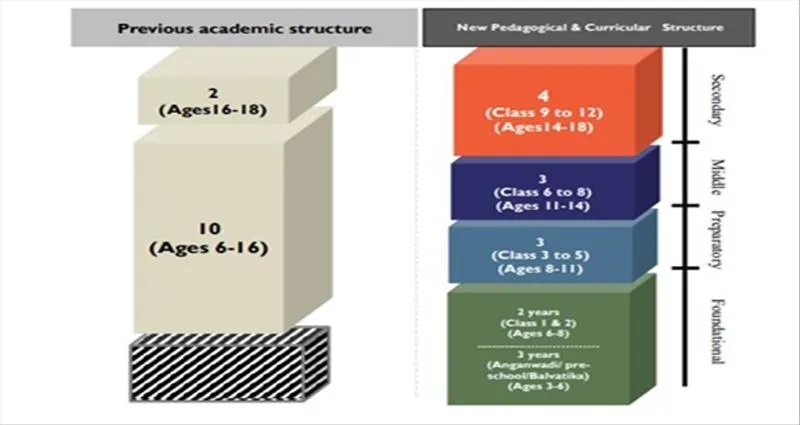
New pedagogical and curriculum framework On a 5 + 3 + 3 + 4 design, a new developmentally suitable curriculum and pedagogical structure for school instruction based on brain development and learning principles has been developed, comprising four stages.
Focus on:
-Empowering students by allowing them to choose from a variety of courses.
-Reduce curriculum content to focus on critical thinking and vital learning.
-Experimental learning, multilingualism, and linguistic power.
-Vocational Professional Education (VPE) and training will be a crucial component of the higher education system.
-Agriculture and technical education are important.
-Teacher education is also important.
-Skill development programmes
·Artificial Intelligence
·Environmental Education
·Holistic Health
·Organic Living
·Design Thinking
·Global Citizenship Education (GCE)
One of the most important objectives of the educational system is to ensure that students are enrolled and attending school. The GER for Grades 6-8 was 90.9 percent, but only 79.3 percent and 56.5 percent for Grades 9-10 and 11-12, respectively.
A New and Forward-looking Vision for India's Higher Education System is Quality Universities and Colleges. To deliver high-quality higher education this strategy anticipates a major overhaul and re-energization of the higher education system. The policy's vision for the current system involves the following important changes:
(a) A higher education system comprised of large, multidisciplinary universities and colleges, with at least one in or near each district, and more HEIs across India that offer medium of instruction or programmes in local/Indian languages;
(b) A more multidisciplinary undergraduate education;
(c) Faculty and institutional autonomy;
(e) Reaffirming the integrity of academic and institutional leadership roles through merit appointments and career progression based on teaching, research, and service;
(f) Establishing a National Research Foundation to reward exceptional peer-reviewed research and to actively foster research
(h) A single regulator for higher education that is “light but firm” in its regulation;
(i) Increased access, equity, and inclusion through a variety of measures, such as increased opportunities for excellent public education; private/philanthropic university scholarships for disadvantaged and underprivileged students; online education and Open Distance Learning (ODL); and all infrastructure and learner support.
Teachers will be hired through a thorough and open selection procedure. Promotions will be merit-based, and a system for multi-source periodic performance reviews will be devised.
Every year, each teacher will be required to participate in at least 50 hours of CPD opportunities for their own professional development, which will be guided by their own interests. Over the time, outstanding school teachers with established leadership and management skills would be taught to take on academic leadership roles.