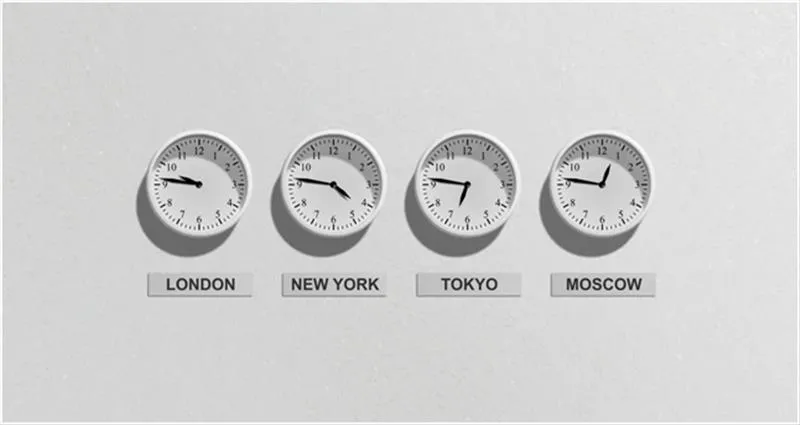
Earth rotates 360 degrees giving us 24 hours or one day; therefore a longitudinal span of 15 degrees corresponds to a shift by an hour. Changlang district is located in the Indian state of Arunachal Pradesh, the eastern-most point, at 27.136° N 97.165° E. Guhar Mota in Kutch district of Gujarat, at 23.713° N 68.032° E is the western-most point of India. India spans a considerable longitudinal difference of 30 degrees from Arunachal Pradesh in the East to western state of Gujarat. Since India has a single time zone, defined by mean longitude at 82.5 degrees east (+5.30 GMT) of the Greenwich Mean Time (GMT), passing through Mirzapur in Uttar Pradesh, resulting in a difference of almost two hours in sunrise from east to west. This causes the loss of many daylight hours by the time offices or educational institutions open, and during winters early sunset leads to higher consumption of electricity. In the eastern most part of our country, many people work in a time zone that is not an appropriate deil cycle for them. Productivity and efficiency of a human being follows a biological clock that is in accordance with the daily light-dark cycles. In Assam people associated with tea gardens follows ‘Chaibagaan time’ which is one hour ahead of India Standard Time (IST). In terms of geographical area, India is the second-largest country after China not to have multiple time zones.
Many research articles have proposed dividing the country in two time zones. In 2006, India’s federal planning commission itself recommended the same. In 2014, the then chief Minister of Assam, Shri Tarun Gogoi pushed the idea of different time zones. He demanded a local time zone which will be ahead of the Indian Standard Time (IST) by at least an hour to 90 minutes for northeastern states. Last year, the CM of Arunachal Pradesh Pema Khandu also said that they get up as early as 4AM, several daylight hours are wasted as government offices open only at 10AM and close by 4PM.
In 2018, a proposal for two time zones has come from India’s national timekeeper itself. Scientists at the Council of Scientific & Industrial Research’s National Physical Laboratory (CSIR-NPL), which maintains Indian Standard Time published a research article describing the necessity of two time zones, which will lead to potential savings in energy consumption of 20 million kWh a year. According to the article, a new time zone is to be introduced which will be an hour ahead of the existing time zone.
At present all commercial places draw power from the grid at the same time, making power plants to operate at higher load factor. Because of different time zones, demand for energy with respect to time can be shared; thereby flattening of the load curve is possible. As India has strongly advocated for fight against climate change, we need to bring down India’s carbon footprint which is possible by reducing energy consumption significantly.
To our fear, if India ever decides to distribute the country into two time zones, there would be chaos because of mismatch in office timings, different working hours for banks. Also it will require synchronizing railway traffic which otherwise may create utter confusion. But several western countries have multiple time zones. France, including its overseas territories, has 12 different time zones, followed by Russia (11) and USA (6). Their countrymen adjust their watches accordingly when they enter into a different time zone. It may be a good idea to explore the possibility of adding one more time zone as it may increase efficiency and decrease power consumption.