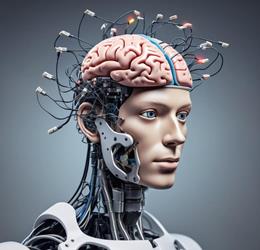
In the realm of humanoid robotics, the integration of advanced artificial intelligence (AI) and machine learning (ML) with cutting-edge controller architectures has the potential to revolutionize robot cognition and autonomy. This paper proposes a novel approach to "Humanoid Robot Brain Mapping" that incorporates a fifth-generation controller, leveraging AI and ML to emulate human-like neural processes in robotic systems. The integration of these technologies enables humanoid robots to process sensory inputs, make informed decisions, learn from experiences, and adapt to dynamic environments, thereby improving their cognitive, interactive, and decision-making abilities. This research presents the methodology and potential applications of this integration, providing a conceptual framework for humanoid robots capable of human-like cognitive functions, decision-making, and complex task execution.
Introduction:
The pursuit of humanoid robots that can think,
reason, and interact like humans has made significant strides with the advent
of advanced AI and machine learning (ML). Humanoid robots, designed to
replicate human appearance and behavior, have found increasing applications in
industries ranging from healthcare and customer service to entertainment and
education. However, the challenge lies in enabling these robots to perform
tasks that require human-like cognitive abilities, such as reasoning,
perception, and decision-making. The integration of these technologies with
advanced controller architectures has opened new possibilities for creating
robots that are not only capable of performing predefined tasks but also adapt
and learn from their environments in a highly dynamic and complex manner.
At the heart of this progress lies the
fifth-generation (5G) controller, which differs from earlier robotic
controllers by incorporating AI and ML algorithms for enhanced decision-making,
learning, and control. These systems allow humanoid robots to operate in a more
autonomous, adaptive, and intelligent manner, much like the human brain
processes sensory inputs and generates appropriate responses. By mapping the
robot’s neural pathways and cognitive processes, it is possible to emulate the
way humans perceive, think, and interact with their environment.
Methodology:
The integration of AI and ML with humanoid robot
controllers involves a multi-faceted approach that draws inspiration from human
brain processes. The concept of brain mapping, in this context, refers to the
process of developing a computational model that simulates the way the human
brain processes sensory inputs, makes decisions, and generates actions. The
goal is to create a robot system that can learn from its environment, adapt its
behaviors, and make intelligent decisions, much like a human would.
The core of the proposed methodology is the use
of a fifth-generation controller, which integrates various AI and ML algorithms
to facilitate real-time learning and decision-making. One of the key components
is the use of deep learning models, particularly deep neural networks (DNNs),
which are employed to process sensory inputs such as vision, sound, and touch.
Reinforcement learning (RL) plays a pivotal role in this brain mapping
framework. The robot learns by interacting with its environment and receiving
feedback, similar to the way humans learn from experience. Through trial and
error, the robot refines its actions to maximize a reward function, improving its
ability to execute tasks such as navigation, object manipulation, and even
social interactions. In addition, transfer learning allows the robot to apply
knowledge gained from previous tasks to new environments or scenarios, thus
enhancing its adaptability.
Another important aspect of the integration is
the hierarchical control architecture that maps the human brain’s cognitive
structure onto the robot’s control system. At the lowest level, the controller
manages basic motor functions and sensory processing. At higher levels, the
system handles more complex tasks such as reasoning, planning, and
decision-making. This tiered approach allows the robot to perform sophisticated
behaviors while maintaining efficiency and flexibility in decision-making.
The fifth-generation controller’s ability to optimize learning through techniques such as neural network optimization and genetic algorithms further improves the robot’s cognitive functions. These techniques enable the robot to fine-tune its internal models, enhance prediction accuracy, and better adapt to dynamic environmental conditions.
Results and Discussion:
The application of this integrated brain mapping
framework has yielded promising results in both simulated and real-world
environments. In a series of controlled experiments, humanoid robots equipped
with the proposed AI-driven fifth-generation controller successfully performed
a range of tasks that require high-level cognitive abilities. These tasks
included object recognition, autonomous navigation in cluttered environments,
and human-robot interaction scenarios.
In object manipulation tasks, the robots
demonstrated the ability to adapt to varying object shapes, sizes, and
textures, selecting the most effective grasping strategy based on sensory
feedback. Reinforcement learning enabled the robots to continuously refine
their grasping techniques, improving accuracy and efficiency over time. This
adaptability was especially evident when the robots were faced with unforeseen
environmental changes, such as obstacles or unfamiliar objects. The integration
of AI and ML allowed the robots to learn new strategies, improving their
performance in real-time.
While the results are promising, several
challenges remain. One of the primary obstacles is the computational complexity
of real-time learning and decision-making. Despite advances in processing
power, the integration of AI and ML algorithms with real-time sensory inputs
requires significant computational resources. The development of more efficient
algorithms and hardware systems will be essential for scaling these
technologies to a broader range of robotic applications.
Additionally, there are ethical considerations
associated with the increasing autonomy of humanoid robots. As robots become
more capable of making decisions and interacting with humans, questions arise
about accountability, safety, and the potential for unintended consequences.
Addressing these ethical issues will be critical as humanoid robots become more
integrated into society.
Conclusion:
The integration of advanced AI, machine learning,
and fifth-generation controllers offers significant potential for enhancing the
cognitive abilities and autonomy of humanoid robots. By mapping the brain-like
functions of perception, decision-making, and learning onto robotic systems, it
is possible to create robots that can perform complex tasks with high levels of
flexibility and adaptability.As technology continues to advance, future work
will focus on optimizing AI algorithms, improving sensor fusion, and addressing
the ethical challenges associated with autonomous robotics.