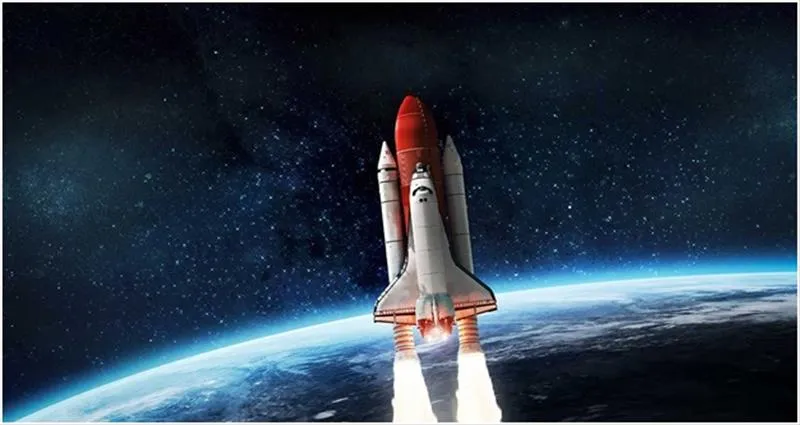
Humans' only means of approaching space remains rockets of various shapes and sizes, but have you ever considered how they work? We hope to shed some light on how these spaceships leave Earth's atmosphere and enter the vast world of space in this essay. Although these complicated machines make taking off from the Earth's surface appear simple, we can tell you that it is a Herculean undertaking. Here's all you need to know about launching a rocket into orbit from Earth..
Exploring the world beyond Earth has long been a goal of inventors and writers, but as time passed and technology advanced, the severe hurdles of sending humans off of Earth became obvious during the 1900s. As a vessel sailed higher and higher, balloon flights were employed as early experiments to test how the Earth's atmosphere was. At greater altitudes, it was discovered that the atmosphere thins rapidly. This provided scientists and engineers with crucial information on “upwards” flight, as vehicles that rely on displacing a medium such as air or water around them to propel ahead, such as aeroplanes and boats, would be useless for this usage.
Rockets were first developed as military weapons or pyrotechnics, and they produced a force in only one direction, known as thrust. This worked on the basis of a reaction-and-action mechanism, in which unstable chemicals produced exhaust fumes that were immediately propelled into the rocket's rear. This enabled the rocket to be propelled in the opposite direction, regardless of the material in which it was contained.
The presence of a specific sort of chemical known as an oxidant on board is the final element to making rockets effective in their journey from Earth to space (and hopefully back again). This essentially restores the oxygen that is depleted in space, allowing fuel to burn continuously whether on Earth or not.
As soon as the rocket takes off, it begins to expel some of its mass through exhaust, and as the weight decreases, the same level of thrust decreases, causing a significant influence on the rocket.
Tsiolkovsky experimented with many various rocket designs during his lifetime, eventually deciding that the ideal setup was a vertical one with multiple “stages.”
A rocket passed through each stage and past it along a certain distance without running out of fuel, before disconnecting specific components and continuing its flight. This approach is still widely employed today, and it allows rockets to carry only the exact amount of weight they need at all times during the launch.
To explain the required thrust force for any precise manoeuvre that a rocket desired to execute, a complex equation was developed. This included a need for any rocket to be able to enter space known as "specific impulse" — the amount of thrust produced in relation to the amount of fuel used.
Surprisingly, many satellites and spacecraft do not travel beyond low Earth orbit (LEO), as those chosen devices that are meant to depart Earth and explore the solar system require a far bigger boost in speed. This is required in order to achieve "escape velocity," which is the speed at which a vessel cannot be dragged back to Earth by gravity. This escape velocity is 6.9 mps (11.2 kilometres per second) near the Earth's surface, which is typically 50 percent faster than objects travelling in LEO.