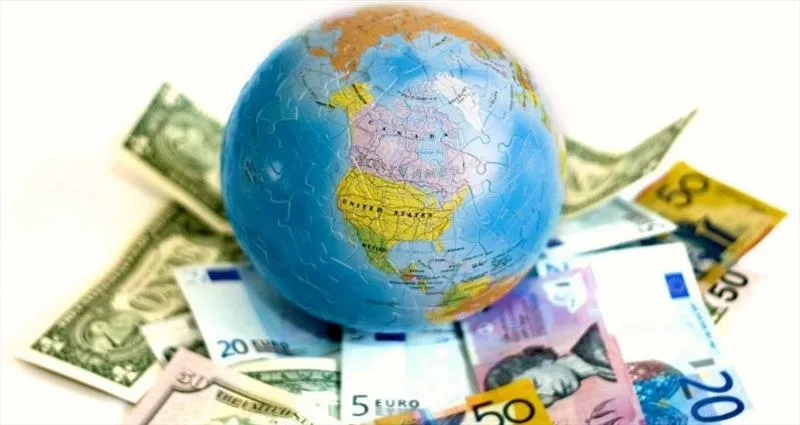
Geo economics is the study of the spatial, temporal, and political aspects of husbandry and coffers. Although there's no extensively accepted singular description, the distinction of geo economics independently from geopolitics is frequently attributed to Edward Luttwak, an American strategist and military adviser, and Pascal Lorot, a French economist and political scientist. Azerbaijani economist Vusal Gasimli defines geo-economics as the study of the interrelations of economics, terrain and politics in the" horizon less cone" rising from the center of the earth to external space (including the profitable analysis of planetary coffers).
There's a" situations of analysis" approach for geo economics, echoing the three situations of analysis approach from geopolitics
(1) A policy sub caste-as in transnational political frugality.
(2) A sale sub caste-as in the deals instanced in fiscal economics.
(3) An integration sub caste-as in profitable terrain and artificial association.
KEY FACTORS OF GEO-ECONOMICS
States engage in geo-profitable competition through both through aiding or directing domestic private realities, or through direct action opposing foreign marketable interests States help private realities through supporting high- threat exploration and development, initiating overseas request- piercing investments, and through product over-investment for request- share forcing. Further directly, countries put levies and proportions on foreign products, bolster nonsupervisory or covert impediments to significances, engage in blinked import backing, initiate public technology programs, and collect profitable and specialized intelligence. According to Luttwak, obnoxious munitions are more important in geo-economics, as they're in war. Also, state- patronized exploration and development is the most important of these munitions. The" army “in this analogy corresponds to marketable product, which can also be supported by the state through colorful forms of subventions. Yet another geo-profitable armament is raptorial finance. However, countries can offer loans at below- request interest rates, If operation subventions are inadequate to allow domestic exporters to overcome strong challengers. The United States’ Export-Import, for illustration, provides loan guarantees to finance exports, and original institutions live across all major artificial countries." Therefore nonnative’s routinely pay lower interest rates than original borrowers, whose levies pay for the veritably concessions that nonnative’s admit. That formerly amounts to hunting for exports with low- interest security, but the blameworthiness of raptorial finance is reserved for cases where interest rates are suddenly reduced in the course of a fought-over trade. Naturally, the principal trading countries have promised to each other that they will do no similar thing. Naturally, they constantly break that pledge. Transnational political frugality (IPE), also known as global political frugality (GPE), is the study of how politics shapes the global frugality and how the global frugality shapes politics. It's a subfield of economics, political wisdom and transnational relations. IPE is most nearly linked to the fields of macroeconomics, transnational business, transnational development and development economics. A crucial focus in IPE is on the distributive consequences of global profitable exchange. It has been described as the study of" the political battle between the winners and disasters of global profitable exchange. The substantial issue areas of the global frugality are constantly divided into four broad areas
1. Transnational trade,
2. The transnational financial system,
3. Transnational pots and
4. Profitable development.