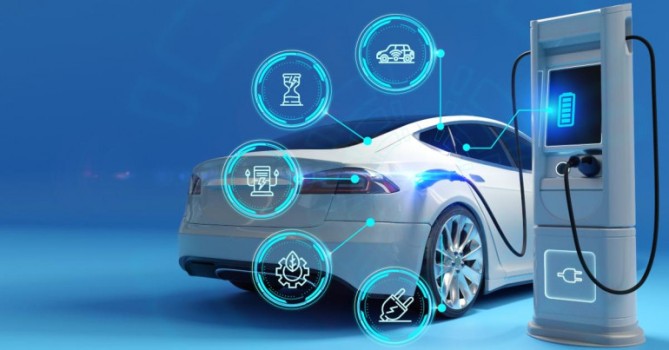
An
Electric Vehicle (EV) is a type of vehicle that is powered entirely or
partially by electricity, rather than gasoline or diesel. Here's a quick
overview:
Types
of Electric Vehicles
1.
Battery
Electric Vehicles (BEVs):
o
Fully
electric; no internal combustion engine.
o
Powered
by electric motors and rechargeable batteries.
o
Examples:
Tesla Model 3, Nissan Leaf.
2.
Plug-in
Hybrid Electric Vehicles (PHEVs):
o
Have
both an electric motor and a gasoline engine.
o
Can
drive on electric power alone for a limited range.
o
Examples:
Toyota Prius Prime, Chevrolet Volt.
3.
Hybrid
Electric Vehicles (HEVs):
o
Use
both electric and gasoline power but can't be plugged in.
o
The
battery is charged through regenerative braking and the internal combustion
engine.
o
Example:
Toyota Prius (standard model).
Key
Components
- Electric Motor
- Battery Pack (usually lithium-ion)
- Inverter
- Charging Port
- Onboard Charger
- Regenerative Braking System
Benefits
- Zero tailpipe emissions (for
BEVs)
- Lower operating costs (fuel and
maintenance)
- Quieter operation
- Incentives (government rebates,
tax credits in many regions)
Challenges
- Limited range (though
improving)
- Charging infrastructure
availability
- Longer refueling time compared
to gas vehicles
- Higher upfront cost (often
offset by long-term savings)
1. Solid-State Batteries (SSB)
- Safer, lighter, and offer
higher energy density compared to traditional lithium-ion.
- Big names like Toyota, Quantum Scape,
and BMW are pushing toward production.
2.
Ultra-Fast Charging
- Charging times are dropping
under 15 minutes thanks to 800V+ architectures (e.g., Porsche Taycan).
- Research into 1MW+ chargers for
trucks (like Tesla Semi) is heating up.
3. Vehicle-to-Grid (V2G) Technology
- EVs can now feed electricity
back to the grid during peak demand.
- Companies like Nissan and Ford
are leading early adoption.
4. AI-Enhanced Battery Management Systems
- Machine learning models
optimize battery health, predict failures, and extend range.
- Smart battery software is
becoming a major differentiator.
5. Modular
and Swappable Batteries
- Nio and Gogoro are making
battery swapping practical, especially in urban fleets and scooters.
6. Connected Cars & Over-the-Air (OTA)
Updates
- EVs are getting smarter with
real-time software updates (Tesla, Rivian, Lucid are examples).
- Remote diagnostics, route
optimization, and feature upgrades are all OTA-driven.
7. Solar Integration
- Companies like Aptera and
Lightyear are putting solar panels directly on EVs for trickle charging.
8. Sustainable Manufacturing
- EV makers are pushing for
greener manufacturing processes: recycled materials, lower CO₂ footprint, and ethical mining
practices.
9. Electrification of Heavy Transport
- Electric trucks, buses, and
delivery vans are becoming more common (think Tesla Semi, Volvo e-trucks,
Rivian vans for Amazon).
10. Wireless Charging (Dynamic and Static)
- Static wireless pads already
exist (BMW, Genesis prototypes).
- Dynamic wireless charging
(charging while driving) is being tested on special roads (like in
Michigan and Sweden).
1.
Electrical Requirements
- Power Supply:
- AC Chargers (Level 1 & 2): 220V–240V single-phase for
home or small commercial.
- DC Fast Chargers: 400V–1000V three-phase supply
needed.
- Transformer/Upgrades:
- Sometimes you need a dedicated
transformer, especially for DC fast chargers.
- Circuit Protection:
- Proper circuit breakers,
fuses, surge protection.
2. Location and Site Requirements
- Accessibility:
- Easy for drivers to access,
preferably close to highways, malls, or workplaces.
- Space:
- Parking spots wide enough for
EVs to park and charge without blocking others.
- Weather Protection:
- Some sites add canopies for
chargers to protect from rain/sun.
3. Connectivity
- Internet Connection:
- For payment systems, remote
monitoring, firmware updates, and data collection.
- OCPP Compliance:
- Chargers should support Open
Charge Point Protocol (OCPP) for flexibility between different
network operators.
4. Payment and Billing Infrastructure
- RFID Cards, Mobile Apps, or
Credit Card Readers
- Some stations are free
(especially workplace/private), but public ones often need integrated
payment systems.
5. Type of Chargers
- Slow Charging (AC Level 1):
- For home use, 8–10 hours for
full charge.
- Fast Charging (AC Level 2):
- 3–5 hours, ideal for
commercial places.
- Rapid Charging (DC Fast Charger
/ Level 3):
- 15–45 minutes for 80% charge,
needs more robust infrastructure.
6. Safety and Compliance
- Certifications:
- UL certification (USA), CE
marking (Europe), or equivalent local certifications.
- Grounding:
- Proper grounding to avoid
electric shocks.
- Emergency Shut-Off:
- Mandatory in many places for
public chargers.
- Fire Safety:
- Fire extinguishers, clear
markings, and possibly CCTV monitoring.
7. Regulatory Approvals
- Permits:
- Electrical permit,
city/municipality approval, zoning clearance, sometimes environmental
assessments.
- Incentives:
- Governments often provide
grants, rebates, or tax credits to install EV stations (worth checking
locally).
8. Sustainable Features (Optional but
Trending)
- Solar-powered EV stations.
- Energy storage with batteries
to reduce peak demand charges.