Overview:
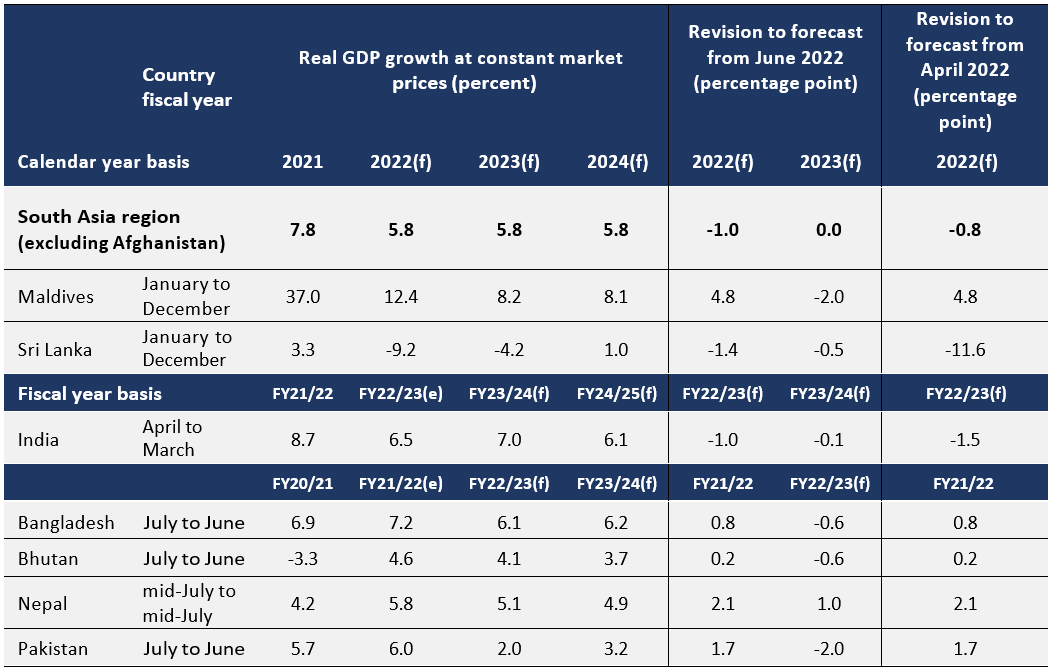
South Asia is facing an unprecedented mix of
shocks, including Sri Lanka's economic disaster, Pakistan's disastrous torrents,
a worldwide downturn, and the effects of the Ukraine conflict, on top of the
residual wounds of the COVID-19 pandemic. Evolution in the area is slowing,
emphasizing the essential for nations to strengthen their resilience.
According to the newest South Asia Economic
Focus, “Handing with Shocks: Migration and the Road to Resilience, regional
growth is expected to average 5.8 percent this year, a 1 % point decrease from
the June estimate. This follows 7.8 percent growth in 2021 when most nations
were recovering from the pandemic decline”.
While economic hardship affects all these
nations, some fare better than others do. India, the region's biggest economy,
has recovered faster than the global average, while its sizable foreign assets
have acted as a safeguard against external shocks. Visit of tourists is helping
to fuel development in the Maldives and, to a minor degree, Nepal, both of
which have thriving service industries. The combined impacts of COVID-19 and inflation
in commodity prices caused by the Ukraine conflict took a greater toll on Sri Lanka,
worsening its debt problems and draining foreign assets. Sri Lanka's real GDP
is projected to decline 9.2 % in 2022 and another 4.2 percent in 2023, as the
country enters its worst economic crisis in decades. High product prices exacerbated Pakistan's
foreign imbalances, reducing its savings. After catastrophic climate change
heavy floods submerged one-third of the country this year, the country's
prognosis remains clouded.
Inflation in South Asia has anticipated to reach
9.2 % this year, owing to rising world food and energy costs, as well as
trade barriers that have exacerbated food insecurity in the
area. The ensuing actual income squeeze is severe, especially for the regions
impoverished, who spend a significant portion of their income on food.
Strategy:
In fiscal 2022, the World Bank authorized $9.0 billion in lending to the
area for 44 activities, including $4.8 billion in IBRD and $4.2 billion in IDA
commitments. We also authorized $6 million in consulting services and
analytical goods for eight nations. These gave detailed guidance on topics like
pandemic preparation and immunization, debt management, job creation, female
labor force involvement, air pollution, catastrophe risk management, and
climate resilience.
Responding to Emergencies
According to the World Bank, the multi-donor
Afghanistan Reconstruction Trust Fund will continue to assist the people of
Afghanistan following the August 2021 political conflict. This funds programs
that support community livelihoods, food security, schooling, basic health
care, and the capacity of non-governmental organizations (NGOs), with an
emphasis on women and girls. UN agencies and foreign nongovernmental groups
carry out these initiatives. We also acted swiftly to assist the people of Sri
Lanka in navigating the worst economic crisis in decades, reallocating funds
from established programs to meet critical needs in health, social security,
agriculture, and energy. We are moving funds from programs to support pressing
needs in the wake of Pakistan's devastating floods, and we are planning
emergency operations for rebuilding and recovery.
Accelerating human capital expenditures
Despite the significant success, South Asia
continues to confront significant and chronic human capital deficits. The
COVID-19 disaster, which has slowed or completely reversed advances has
exacerbated these. Children born in the area today can expect to achieve only
48% of their maximum potential. A $125 million initiative in India is assisting
the state of West Bengal in developing a consolidated social registry, which
will increase coverage and access to social aid for impoverished and
disadvantaged groups. In Pakistan, we are assisting with a number of federal
and provincial activities aimed at improving basic health and education results,
boosting incomes, expanding targeted social safety networks, and strengthening
disaster preparation.
Increasing the economy's strength
World Bank assists nations in generating new
sources of opportunity, development, and employment by promoting private-sector-led
solutions, improved debt and investment transparency, SMEs' access to markets
and financing, and digital change. Our study looks at how nations can
transition from manufacturing-led growth to a services-led development model
that improves long-term resilience.
In Bangladesh, we are assisting in the
development of a better fiscal and finance sector, the modernization of taxes,
and the promotion of an internationally competitive export industry. We also
promote cash transmission systems that can react to extreme weather disasters
like floods and cyclones more quickly. A $150 million effort in Nepal is
assisting in increasing financial sector security, diversifying financial
solutions, increasing access to financial services, and opening up capital,
insurance, and disaster risk.
Green development promotion
Floods threaten approximately 80% of South
Asia's main towns, and increasing sea levels pose storm surge dangers for
low-lying, heavily inhabited coastal regions. Water and agricultural networks are
especially vulnerable. Water shortage is being caused by more variable rainfall
and higher temperatures, which is decreasing agricultural yield and influencing
food costs, nutrition, and farmers' incomes. Climate change has the potential
to drastically reduce living circumstances for up to 800 million people across
the area.