Clustered
Regularly Interspaced Short Palindromic Repeats (CRISPR) is a gene editing technology, which replicates the natural defense mechanism in
bacteria to fight virus attacks, using a special protein called Cas9.
o It
usually involves the introduction of a new gene, or suppression of an existing
gene, through a process described as genetic engineering.
·
CRISPR technology does not involve the introduction of any new gene from the
outside.
o
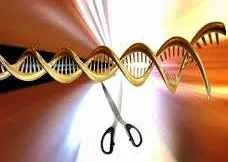
CRISPR-Cas9 technology is often described as ‘Genetic Scissors’.
· Its
mechanism is often compared to the ‘cut-copy-paste’, or ‘find-replace’
functionalities in common computer programs.
· A bad
stretch in the DNA sequence, which is the cause of disease or disorder, is
located, cut, removed, and then replaced with a ‘correct’ sequence.
· The
tools used to achieve this are biochemical i.e., specific protein and RNA
molecules.
o The
technology replicates a natural defense mechanism in some bacteria that uses a
similar method to protect itself from virus attacks.
Mechanism:
o The
first task is to identify the particular sequence of genes that is the cause of
the trouble.
o Once
that is done, an RNA molecule is programmed to locate this sequence on the DNA
strand, just like the ‘find’ or ‘search’ function on a computer.
o After
this Cas9 is used to break the DNA strand at specific points, and remove the
bad sequence.
o A DNA
strand, when broken, has a natural tendency to re-attach and heal itself. But
if the auto-repair mechanism is allowed to continue, the bad sequence can
regrow.
· So,
scientists intervene during the auto-repair process by supplying the correct sequence
of genetic codes, which attaches to the broken DNA strand.
· It is
like cutting out the damaged part of a long zipper and replacing it with a
normally functioning part.
o The
entire process is programmable, and has remarkable efficiency, though the
chances of error are not entirely ruled out.
What
is the Significance of CRISPR-based Therapeutic Solutions?
§
Specific Treatment: CRISPR aids in disease treatment by correcting the
underlying genetic problem. CRISPR-based therapeutic solutions are not in the
form of a pill or drug. Instead, some cells of every patient are extracted, the
genes are edited in the laboratory, and the corrected genes are then
re-injected into the patients.
o What
is to be edited, and where, is different in different cases. Therefore, a
specific solution needs to be devised for every disease or disorder that is to
be corrected.
· The
solutions could be specific to particular populations or racial groups since
these are also dependent on genes.
· The
changes in genetic sequences remain with the individual and are not passed on
to the offspring.
§ Permanent
Cure of Genetic Diseases/Anomalies: A vast number of diseases and
disorders are genetic i.e.; they are caused by unwanted changes or mutations in
genes.
o These
include common blood disorders like sickle cell anemia, eye diseases including
color blindness, several types of cancer, diabetes, HIV, and liver and heart
diseases. Many of these are hereditary as well.
o
CRISPR opens up the possibility of finding a permanent cure for many of these
diseases.
o
Deformities like stunted or slow growth, speech disorders, or inability to
stand or walk arise out of abnormalities in gene sequences.
·
CRISPR presents a potential treatment for the cure of such abnormalities as
well.