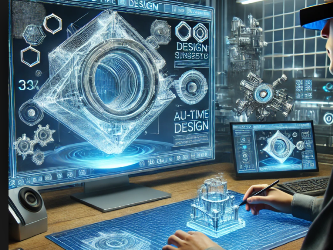
Computer-Aided
Design (CAD) is a powerful technology that has transformed the design and
engineering industry over the past few decades. CAD refers to the use of
computer software to create, modify, analyze, and optimize designs. It enables
designers, engineers, architects, and manufacturers to create detailed 2D and
3D models of physical objects and structures with high precision and
efficiency. CAD has become an essential tool in various industries, including
mechanical engineering, civil engineering, electrical engineering, aerospace,
automotive, construction, and product design. Its ability to simulate
real-world conditions and predict how designs will perform has made it an
indispensable part of modern engineering and manufacturing processes.
Evolution
and Current State of CAD
The origins
of CAD can be traced back to the 1950s and 1960s, when early computer systems
were used for numerical control and design automation. One of the first major
developments in CAD was the development of the Sketchpad system by Ivan
Sutherland in 1963, which allowed users to create graphical images using a
light pen on a computer screen. Throughout the 1970s and 1980s, advancements in
computing power and software capabilities led to the development of more
sophisticated CAD systems. Companies such as Autodesk, Dassault Systèmes, and
PTC emerged as key players in the CAD industry, offering specialized software
for various design and engineering applications.
Modern CAD
software offers a wide range of features, including 3D modeling, parametric
design, finite element analysis (FEA), computer-aided manufacturing (CAM)
integration, and real-time collaboration. Popular CAD software platforms such
as AutoCAD, SolidWorks, CATIA, Siemens NX, and PTC Creo allow engineers and
designers to create complex models, simulate their performance, and optimize
them for manufacturing. The ability to integrate CAD with other technologies,
such as computer-aided engineering (CAE) and computer-aided manufacturing
(CAM), has created a seamless workflow from design to production.
Benefits and
Applications of CAD
The adoption
of CAD has revolutionized the design and manufacturing industries by improving
accuracy, reducing design time, and enabling the creation of complex geometries
that would be difficult or impossible to achieve with traditional drafting
methods. CAD software allows designers to create detailed models with precise
measurements, which helps in identifying potential design flaws before
production. This reduces material waste, lowers production costs, and improves
overall product quality.
In the field
of mechanical engineering, CAD is used for designing machine parts, assemblies,
and manufacturing processes. It enables engineers to perform stress analysis,
thermal analysis, and motion simulation to ensure that components will perform
as expected under real-world conditions. In civil engineering and architecture,
CAD is used for creating detailed building models, structural analysis, and
visualization of architectural designs. Electrical engineers use CAD for
designing circuit boards, wiring diagrams, and control systems. CAD is also
widely used in the automotive and aerospace industries for designing vehicles,
aircraft, and spacecraft, optimizing aerodynamics, and improving fuel
efficiency.
Future
Prospects of CAD
The future
of CAD is closely tied to advancements in artificial intelligence (AI), machine
learning, cloud computing, and virtual reality (VR). AI and machine learning
are expected to enhance CAD capabilities by automating repetitive tasks,
suggesting design improvements, and optimizing complex geometries. Generative
design, powered by AI, allows CAD software to create multiple design
alternatives based on specified constraints and performance goals. This helps
engineers and designers explore innovative solutions that may not have been
possible through traditional methods.
Cloud-based
CAD platforms are becoming increasingly popular, allowing designers and
engineers to collaborate in real-time from different locations. Cloud-based CAD
also provides access to high-performance computing resources, enabling faster
simulations and analysis. The integration of VR and augmented reality (AR) with
CAD software will enable designers to visualize and interact with their designs
in an immersive environment, improving understanding and communication of
complex designs.
Another
major trend shaping the future of CAD is the rise of additive manufacturing (3D
printing). CAD models can be directly used to create 3D-printed prototypes and
final products, enabling rapid prototyping and customization. This will reduce
production lead times and enable manufacturers to produce complex parts with
minimal material waste.
Furthermore,
the growing focus on sustainability and eco-friendly design is expected to
drive innovations in CAD software. Designers will be able to use CAD tools to
analyze the environmental impact of their designs, optimize material usage, and
explore alternative materials with lower carbon footprints. CAD will play a
critical role in the development of smart cities, renewable energy systems, and
sustainable infrastructure.
Conclusion
In
conclusion, CAD has become a cornerstone of modern design and engineering,
enabling the creation of complex models and improving efficiency across various
industries. The future of CAD is poised to be shaped by advancements in AI,
cloud computing, VR, AR, and additive manufacturing. As these technologies
continue to evolve, CAD will become even more powerful and capable, driving
innovation and transforming the way products and structures are designed,
analyzed, and manufactured. The increasing integration of CAD with other
digital tools and the growing demand for sustainable solutions will ensure that
CAD remains a vital tool for engineers and designers in the decades to come.