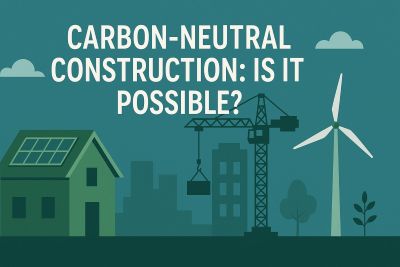
As
climate change picks up pace, all industries worldwide are being put under
pressure to minimize their carbon footprint, and the construction industry is
no different. In fact, the construction and built environment sector emits
close to 40% of the carbon dioxide emissions of the world if both operational
and embodied carbon is taken into consideration. This has sparked increased
interest in carbon-neutral building, something that seeks to remove or balance
out all the carbon emissions that are involved when constructing. But is
carbon-neutral building actually feasible, or is it merely an idealistic
concept?
Carbon-neutral
building, or net-zero carbon building, is designing, constructing, and
operating infrastructure such that there are no net carbon emissions released
into the air. It includes all the way from lowering the carbon trapped in
building materials to lessening energy use at the time of operation of the
building. Wherever carbon emissions cannot be avoided, they are offset by
environmental credits like afforestation or renewable energy credits. The
concept is to consider the whole life span of a building—from raw material
extraction all the way to its demolition—and have its net effect on atmospheric
carbon equal to zero.
To
understand the feasibility of carbon-neutral construction, it is important to
first grasp where carbon emissions originate in a typical project. The major
contributors include embodied carbon, which arises from the production and
transport of construction materials like cement, steel, and bricks. Operational
carbon is another significant factor—it comes from the energy required to run a
building once it’s in use, such as electricity for lighting, heating, and
cooling. Moreover, there are end-of-life emissions, emitted when building
materials are demolished and sent for disposal. All of these emissions together
create a complicated web that must be accounted for in order for any project to
be deemed carbon-neutral.
Technically,
carbon-neutral construction is achievable. Over the last decade or so, many
buildings and small-scale infrastructure projects internationally have been
planned and constructed with net-zero carbon targets. However, the challenge lies
in scaling these innovations across the entire construction industry. The
current systems for material production, project financing, regulatory
approvals, and construction practices are still heavily dependent on
carbon-intensive processes. Moving toward a carbon-neutral future will require
not only technical advancements but also cultural and systemic shifts across
the entire ecosystem of civil engineering.
Green
concrete, which substitutes a proportion of cement with industrial waste such
as fly ash or slag, cuts CO₂
production by a lot. Engineered wood, such as cross-laminated timber (CLT), is
yet another material that is becoming increasingly popular due to its capacity
to store carbon and renewability. Similarly, recycled steel and green bricks
such as AAC blocks are also being used in various green buildings. These have
not only reduced embodied carbon but also improve the thermal and structural
efficiency of buildings.
Along
with materials, energy-efficient design is also crucial in minimizing operational
carbon. Structures that are designed using passive solar principles, favorable
orientation, and insulation can significantly minimize the requirements for
artificial heating and cooling. Intelligent glazing systems, low-energy
lighting, and ventilation systems further optimize energy conservation. Further
advanced systems even incorporate sensors and automation technologies to
monitor and regulate building performance in real-time, maintaining optimal
energy usage without compromising comfort.
In
order to come closer to carbon neutrality, buildings are now producing their
own power using renewable resources. Solar panels on roof-tops and facades,
small wind turbines, and geothermal systems are becoming increasingly
widespread in green building design. When a building is able to produce as much
clean energy as it uses, it becomes net-zero operational carbon. Some ambitious
buildings even return surplus power to the grid, with net-positive energy
performance.
Civil
engineers are at the forefront of the transition towards carbon-neutral
building. From planning to execution stages, engineers decide on sustainable
materials, streamline structural design, and liaise with architects and
contractors to ensure energy efficiency results. They also perform life cycle
assessments (LCA) to measure a project's carbon footprint and track emissions
during construction. As the world's engineers march towards the future, civil
engineers will have to keep up with new technologies, green practices, and
carbon accounting methodologies to successfully spearhead the shift.
There
are several projects worldwide that already prove carbon-neutral construction
is not a pipedream. The Bullitt Center in Seattle, USA, is perhaps best known
as the greenest commercial building in the world. It relies on solar panels,
rainwater harvesting, and composting toilets to reduce its carbon footprint. In
Europe, The Edge in Amsterdam is an intelligent office building that employs
renewable energy and smart systems to function with negligible carbon
emissions. Even in infrastructure, nations such as the UK and Sweden are
testing solar roads and low-emission asphalt to minimize the carbon impact of
highways.
In
India, there is great potential for carbon-neutral building, with the country's
urbanization and infrastructural growth at a breakneck pace. Schemes such as
GRIHA (Green Rating for Integrated Habitat Assessment), the National Smart
Cities Mission, and Indian Road Congress guidelines to utilize fly ash and
plastic waste in road construction are appreciable moves. Yet, these moves
require large-scale implementation, particularly in minor towns and rural
regions where affordability and awareness continue to be constraints.
In
conclusion, carbon-neutral building is not only an option—it's a need. If the
world is going to be able to achieve the goals outlined in the Paris Agreement
and continue toward a future that is sustainable, the building industry has to
change its ways. This will mean rethinking materials, design, energy sources,
and even what constitutes a successful project. The path forward is difficult,
but it's also full of possibility for innovation and leadership. As civil
engineers, we are not merely constructors of buildings—we are also the
designers of a sustainable future. The time to act is now.