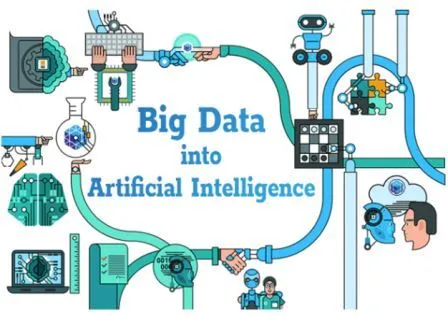
Before anybody ever knew big data
existed, it had already taken over the globe. Big data had amassed an enormous
quantity of stored information by the time the term was created, which, if
correctly examined, might provide insightful knowledge about the sector to
which that specific data belonged.
AI and big data work together well.
AI is used by big data analytics to improve data analysis. In turn, AI needs a
vast amount of data to learn from and enhance decision-making. Big data refers to extremely large, intricate, and
fast-moving databases. Big data, as was already said, is what drives the
development of AI's ability to make decisions. For information and insights,
big data may be investigated and examined. The purpose of big data analytics is
to combine and analyse enormous information in order to find patterns and
provide actionable insights. Big data analytics uses techniques and
technologies, such as AI and machine learning. This enables you to take
quicker, wiser decisions based on data, which may boost productivity, income,
and profitability.
Artificial intelligence is the name
given to a group of technologies that allow computers to mimic human intellect.
Speech recognition, controlling virtual assistants like Alexa to carry out
tasks, picture recognition for identification, and autonomous driving are some
examples of AI. Additionally, AI increases the capability and accessibility of
augmented analytics tools, enabling you to examine and analyze vast,
unstructured data to better understand the many elements affecting your
company.
AI has several subfields, such as
AutoML and machine learning, which use algorithms to learn and carry out tasks
without human intervention, deep learning, which employs neural networks to
find intricate patterns in massive amounts of data, cognitive computing, which
mimics how the human brain works to solve challenging problems, and natural
language processing, which enables computers to comprehend and interpret human
language.
Artificial intelligence and big data
work well together. To learn and enhance decision-making processes, AI needs a
vast amount of data, and big data analytics uses AI to improve data analysis.
With this convergence, you may more quickly surface useful insights from your
large stockpiles of data and more readily use sophisticated analytics
capabilities like augmented or predictive analytics. You can encourage data
literacy throughout your company and reap the rewards of being a fully
data-driven business by providing your users with the user-friendly tools and
reliable technology they need to extract high-value insights from data using
big data AI powered analytics.
AI can help users at every stage of
the big data cycle, which refers to the procedures involved in collecting, storing,
and retrieving various kinds of data from multiple sources. These include goal
and risk management as well as data management, pattern management, context
management, decision management, and action management.
AI uses natural language processing
to detect knowledge, identify different forms of data, and discover potential
relationships between datasets. It may be used to facilitate data exploration
as well as automate and expedite data preparation operations, such as creating
data models. It can recognise and correct probable information problems by
learning common human mistake patterns. Additionally, it may learn by observing
how a user uses an analytics application, quickly exposing unexpected insights
from huge datasets.
In order to aid users in
comprehending numerical data sources, AI may also be trained to pick up on
minute changes in meaning or context-specific subtleties. Additionally, it may
notify users of data abnormalities or unusual trends, actively tracking
occurrences and spotting possible dangers, for instance, from system logs or
social networking data.
In terms of each field's technical
advancement and study, big data and artificial intelligence are also related.
AI relies on enormous amounts of data, supporting big data technologies, and AI
theories and approaches to advance and develop decision-making abilities.
A decade ago, it was impossible to
get as detailed information about consumer habits, likes and dislikes,
activities, and personal preferences as is now possible thanks to the internet.
Insightful data may be added to the big data pool through social media accounts
and online profiles, social activity, product evaluations, tagged interests,
"liked" and shared material, loyalty/rewards apps and programme, and
CRM (customer relationship management) systems.
Artificial intelligence and big data
are now seen as being inseparable due to AI's capacity to work excellently with
data analytics. Every data input is being used by AI machine learning and deep
learning, and these inputs are being used to create new rules for next business
analytics. However, issues emerge when the data being used is subpar data.
Big data is no longer a novel idea
for businesses. It has evolved into a crucial component of company operations,
particularly for large corporations who place great stock on the ability to
gain insights from their data. Data science is where science meets AI. The
field has expanded despite the epidemic.Data science is becoming more
accessible thanks to the current innovations, one of which is automated machine
learning, or AutoML. The tedious and time-consuming activities of data
preparation and purification take up a significant portion of a data
scientist's employment. Building models, developing algorithms, and developing
neural networks are all part of the automated machine learning (AutoML)
process.
TinyML is a subset of ML that
condenses deep neural networks to fit on any hardware. One of the most
intriguing developments in data science, with which many applications may be
constructed, is its adaptability, small form size, and affordability. It embeds
AI on compact hardware and fixes the power and space issues that occur with
integrated AI.
Monitoring equipment and ensuring
safety are made easier with the use of audio analytics. TinyML may be utilised
for motion, gesture, and visual recognition in addition to audio.
Sensitive EMR and patient data cannot
be compromised with AI permeating so many sectors, including the healthcare
industry. While the machine learns to do it on its own, data privacy by design
will help establish a safer strategy to gathering and processing user data.
AIaaS: It refers to companies that
provide pre-packaged AI solutions that let customers grow and use AI at a
minimal cost. OpenAI has made the public aware that it will make GPT-3, their
transformer language model, accessible through an API. One of the most recent
trends is the provision of cutting-edge models as services, or AIaaS.
Big data, predictive analytics, and
artificial intelligence are just a few of the technologies that are used in
data science, along with both practical and theoretical applications of
concepts. Big data and AI can combine to provide greater results. Data
is first put into the AI engine to increase its intelligence. Additionally,
less human involvement is required for the AI to function correctly. Finally,
society will be closer to achieving the full potential of this continuing
AI/big data cycle the less dependent it is on humans to operate it. At this
point, big data is unquestionably here to stay, and artificial intelligence
(AI) will continue to be in high demand. AI is meaningless without data, yet
mastering data is impossible without AI, therefore data and AI are melding into
a synergistic connection.