1.0
Introduction:
2.0
AI role in Education:
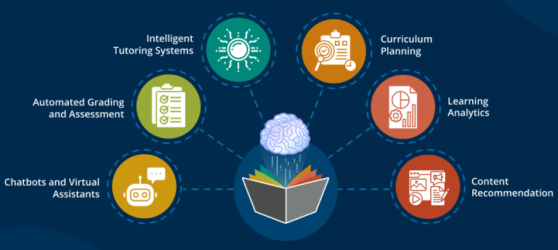
AI in education includes a comprehensive range of applications that increases both teaching and education experiences. The main roles of Artificial Intelligence in education involve:
Tailored Learning:
AI
allows the foundation of personalized education experiences by investigating
student’s education patterns, preferences and performance. Adaptive education
systems can regulate the difficulty level and type of content available to each
student, guaranteeing customized learning path.
·
Intelligent Teaching Systems:
AI-powered
teaching systems provide one-on-one instruction to students, offering
personalized feedback and support. These systems can classify areas where
students struggle and deliver targeted interferences to advance understanding
and performance.
·
Automated Administrative Tasks:
AI
streamlines administrative tasks such as grading, scheduling and resource
allocation. Computerized grading systems can calculate assignments and exams,
providing prompt feedback to students and freeing up educator’s time for more serious
tasks.
·
Improved Student Engagement:
AI
tools, such as chatbots and virtual assistants, better student engagement by
providing real-time assistance and cooperating education experiences. These
tools can answer student’s queries, provide study tips and enable access to knowledge
resources.
3.0
Important AI Tools in Education:
Several
AI tools are making significant contributions to the educational landscape.
This section highlights some of the most impactful tools and their
applications.
Ø Adaptive
Knowledge Platforms:
Ø Automated
Essay Scoring:
Ø Virtual
Assistants and Chabot:
Ø List of AI tools with their purposes and URLs
|
S.No. |
Name of AI Tool |
Purpose |
URL |
|
1 |
Gamma |
Interactive presentations and storytelling |
|
|
2 |
Merlin |
AI-powered
search and research assistant, read research paper and convert it into your
language |
|
|
3 |
sci-hub |
Access to academic papers and research articles |
|
|
4 |
Playground |
AI
development and testing platform |
|
|
5 |
yoodli |
AI-powered public speaking coach, mock interview
preparation |
|
|
6 |
gemini |
Google’s
AI assistant for writing complicated code |
4.0
AI Benefits in Education:
·
Personalized education experiences lead
to better student performance and engagement. By providing to individual education
needs, AI assist students understand complex concepts more efficiently.
·
AI automates tedious tasks, allowing coaches
to emphasis on more impactful happenings such as mentoring and curriculum expansion.
This better efficiency leads to improved educational results.
·
AI delivers valuable data and insights
into student performance and education patterns. Instructors can use this data
to classify trends, predict forthcoming performance and modify instructional
strategies to meet student’s requirements.
·
AI tools care varied learners including
those with incapacities. Assistive skills such as speech-to-text and
text-to-speech applications make education more reachable and comprehensive.
5.0
Future of Artificial Intelligence in education:
·
Innovative Personalization adapting
to student’s emotional states and learning preferences in real time.
·
AI will support lifelong learning by
providing tailored education experiences outside formal education providing to
individual’s career and personal growth needs.
·
AI will enable partnership among
students and teachers worldwide, endorsing global education communities and
cross-cultural understanding.